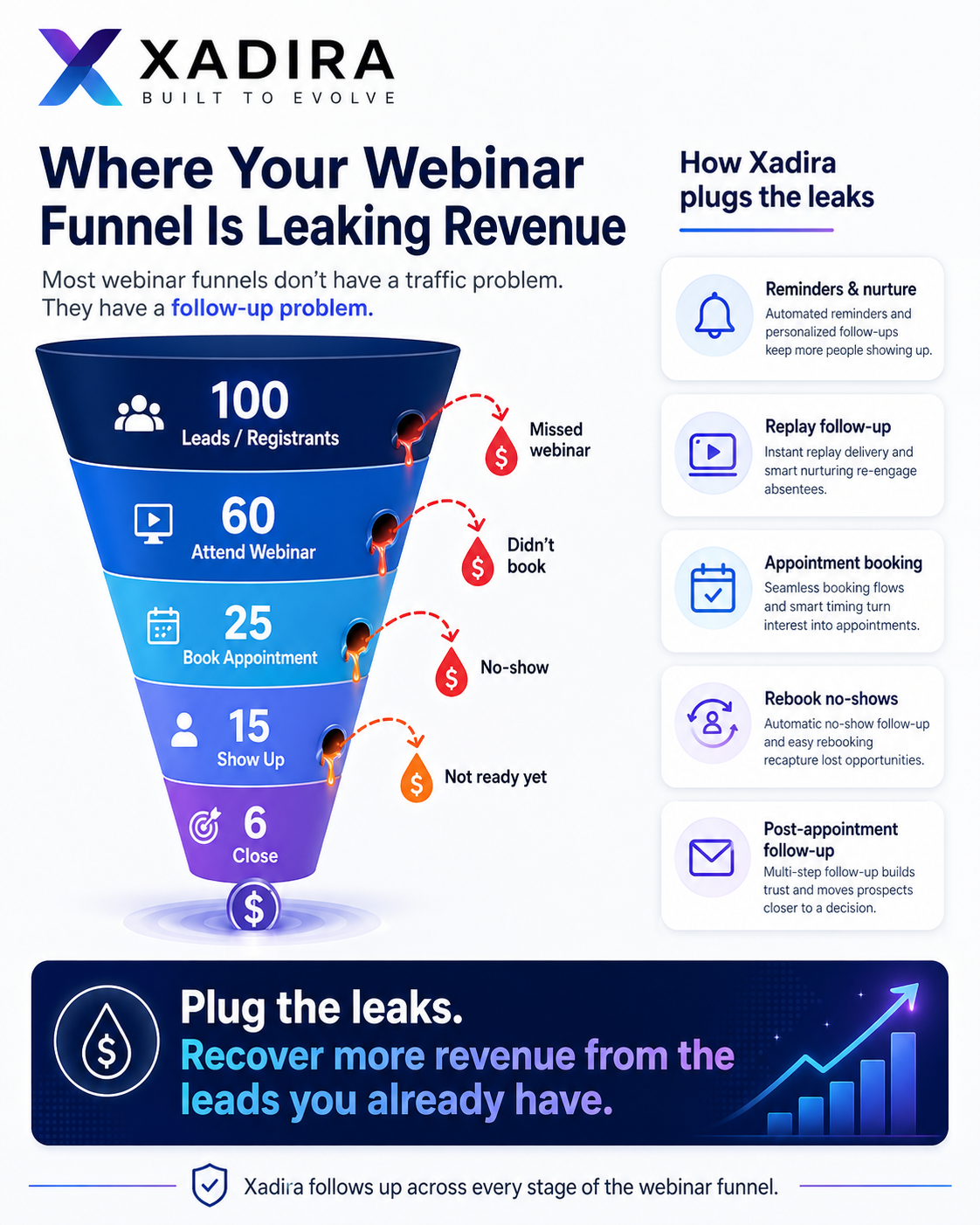
If you're spending money to generate Medicare webinar leads, the most expensive thing you can do is treat the registration as the win. The registration is the start. Everything that happens between registration and a closed policy is where the funnel either holds together or falls apart — and for most agents, it falls apart in four predictable places.
What follows is the math on a typical 100-lead webinar funnel, the four leaks that drain it, and what plugging each leak actually looks like in practice.
The Math: 100 Leads In, 6 Closes Out
Here's a realistic baseline for an unmanaged Medicare webinar funnel. The numbers vary by market, ad quality, and offer — but the shape of the leak is remarkably consistent across agents we've talked to.
- 100 registrants — people who saw your ad, clicked, and gave you contact info
- 60 attend the webinar (40 leak: missed webinar)
- 25 book an appointment (35 leak: attended but didn't book)
- 15 show up for the appointment (10 leak: no-show)
- 6 close as clients (9 leak: not ready yet, no follow-up after the call)
Six clients out of 100 registrations. A 6% end-to-end conversion. That's the baseline most agents quietly accept as "the way webinars work." It's not. It's the way unmanaged webinars work. Each leak in that funnel can be plugged, and the math compounds quickly when you do.
Going from 6 closes per 100 leads to 12 closes per 100 leads doesn't require doubling your ad spend. It requires plugging the leaks in the funnel you already have.
Leak #1: Missed the Webinar (40 of 100)
This is the largest single leak in the funnel and the one most agents underestimate. Roughly 40% of registrants don't show up live. They didn't suddenly lose interest — they got busy, forgot, or the calendar event got buried. They are still warm leads, by definition: they registered.
The cost of leaving this leak
If you do nothing, those 40 leads convert at near zero. A single "sorry you missed it" email recovers maybe 2 to 4 of them. A real absentee track can pull 10 or more back into the funnel.
How to plug it
Treat absentees as their own segment with their own sequence. They need:
- Immediate replay link delivery (within minutes of the webinar ending)
- A reminder to actually watch the replay 24 to 48 hours later
- A short summary or highlight of the most important point they missed
- A direct option to book a 1-on-1 if they're ready
- An invite to the next live session if they prefer to attend live
This sequence isn't long — five to seven well-timed touches over two weeks — but it dramatically changes the recovery rate from this group.
Leak #2: Attended But Didn't Book (35 of the 60 Attendees)
Of the 60 people who attend, only about 25 book on average. The other 35 are the most expensive missed conversions in the funnel — high-intent leads who consumed your full presentation and walked away without taking the next step.
The cost of leaving this leak
Without targeted follow-up, attendees who don't book are usually lumped into the same generic email drip as everyone else. That's a mistake. They have higher intent than registrants, more context than absentees, and need a fundamentally different message. A dedicated follow-up sequence for this segment typically recovers 8 to 12 additional bookings on a 60-attendee webinar.
How to plug it
The sequence for "attended but didn't book" should:
- Acknowledge they attended (not generic — specific to the webinar)
- Address the most common reasons people don't book in the moment (need to talk to spouse, want to compare plans, weren't sure about timing)
- Offer a low-friction path to schedule with no pressure
- Include a soft "what's holding you back?" prompt that invites a reply
- Continue for several weeks before downgrading to long-term nurture
The goal isn't to push harder. It's to recreate the moment of decision and remove the friction that prevented action the first time.
Leak #3: Booked But No-Showed (10 of the 25 Bookings)
Booking is not closing. About 40% of booked appointments end in a no-show — sometimes higher, depending on how far out the appointment is and how strong the reminder system is. These leaks are particularly costly because the lead has already invested time and explicit interest. Losing them to a calendar accident is brutal.
The cost of leaving this leak
A no-show without a recovery sequence is almost always a permanent loss. The lead feels embarrassed about missing, the agent feels frustrated, and the relationship quietly ends. With a proper recovery sequence, 50% to 70% of no-shows can be rebooked — meaning 5 to 7 of those 10 lost appointments can be recaptured.
How to plug it
A no-show recovery system needs three layers:
- Pre-appointment confirmation across channels (email + text), with a 24-hour reminder and a 1-hour reminder
- One-click rescheduling built into every reminder, so a prospect with a conflict can reschedule before missing
- Automatic recovery sequence the moment the appointment is missed: a non-judgmental message acknowledging life happens, with an easy path to rebook
The recovery message has to go out fast — within a couple hours of the missed appointment. Wait a day and the recapture rate drops sharply.
Leak #4: Showed Up But Not Ready Yet (9 of the 15 Show-Ups)
Of the 15 prospects who actually show up to their appointment, only about 6 close as clients on or near that call. The other 9 had a real conversation, got real value, and then left without committing — usually because of timing, not lack of interest.
The cost of leaving this leak
Most agents don't have a structured post-appointment follow-up sequence. They put a reminder on their calendar to "check in next month" and then get busy. The 9 leads who needed more time slowly fade — often closing with a different agent who happened to follow up at the right moment.
How to plug it
Post-appointment leads who didn't close need a different track than every other segment. They've had a 1-on-1 with you. They have specific objections, specific timing concerns, specific blockers. The follow-up needs to:
- Reference what was actually discussed on the call (not generic)
- Address the specific objection or hesitation that came up
- Provide additional information directly relevant to their situation
- Maintain regular contact through their decision window without becoming pushy
- Re-escalate to a direct call when the timing condition is met (e.g., approaching enrollment)
Done well, this segment converts another 3 to 5 of the 9 leaks — sometimes more, depending on the time horizon and quality of the original conversation.
The Compound Effect of Plugging Every Stage
Pull the math together with a managed funnel and the picture changes dramatically:
- 100 registrants
- ~70 effective engagements (60 live + 10 from absentee recovery)
- ~37 bookings (25 baseline + 12 from attended-but-didn't-book recovery)
- ~30 show-ups (15 baseline + 6 rebooked from no-shows + better confirmation)
- ~12 closes (6 baseline + 6 from post-appointment nurture)
Doubled close rate. Same ad spend. Same registrants. The only thing that changed is what happens after registration.
Unmanaged vs. Managed Funnel
Unmanaged
- 1 generic absentee email
- Same drip for all attendees
- Single appointment reminder
- No-show = permanent loss
- Post-appointment = "I'll check in"
- Result: 6 closes / 100 leads
Managed
- Dedicated absentee track with replay
- Distinct attendee/non-booker sequence
- Multi-channel reminders + reschedule
- Automated no-show recovery in hours
- Post-appointment nurture per objection
- Result: 12+ closes / 100 leads
How Xadira Plugs Every Leak Automatically
Xadira is purpose-built for the four leaks above. Each lead's behavior automatically routes them into the appropriate sequence:
- Missed the webinar? Enters the absentee track with replay delivery and reschedule path.
- Attended but didn't book? Enters the high-intent attendee re-engagement sequence.
- Booked the appointment? Multi-channel confirmations and reminders, with automatic no-show recovery if missed.
- Had the appointment but didn't close? Enters post-appointment nurture, kept warm through the prospect's actual decision window.
None of this requires the agent to remember anything, manually tag anyone, or chase down leads in a spreadsheet. The funnel runs the funnel. The agent shows up to the appointments and closes the policies.
Frequently Asked Questions
How realistic are the conversion improvements in this article?
The numbers are conservative for a funnel going from "nothing in place" to "every leak addressed." Some agents see larger gains — particularly on the no-show recovery, which is one of the highest-ROI fixes since the leads are already deep in the funnel. The exact lift depends on offer, market, and the strength of the underlying webinar.
Do I need to fix all four leaks at once?
No. Fix the largest leak first. For most agents, that's "attended but didn't book" — the segment is large, the intent is high, and the recovery effort is straightforward. No-show recovery is also a high-impact, low-effort fix to prioritize early.
Won't more aggressive follow-up annoy my leads?
The goal isn't more aggressive — it's more relevant. Sending the same message 9 times annoys people. Sending different, behavior-appropriate messages over time at sensible intervals doesn't. Frequency complaints almost always come from poor segmentation, not from volume itself.
How long until I see results from plugging these leaks?
Recovery from absentees, no-shows, and recent attendees typically shows up within the first 30 days — those leads are still warm and react quickly to better follow-up. Long-term nurture and post-appointment recovery compounds over 60 to 180 days as your database matures and more leads cycle through their decision windows.
Plug the Leaks. Recover the Revenue.
Xadira automatically catches every leak in your webinar funnel — from missed registrations to post-appointment nurture — so the leads you already paid for actually become clients.
See How Xadira Works