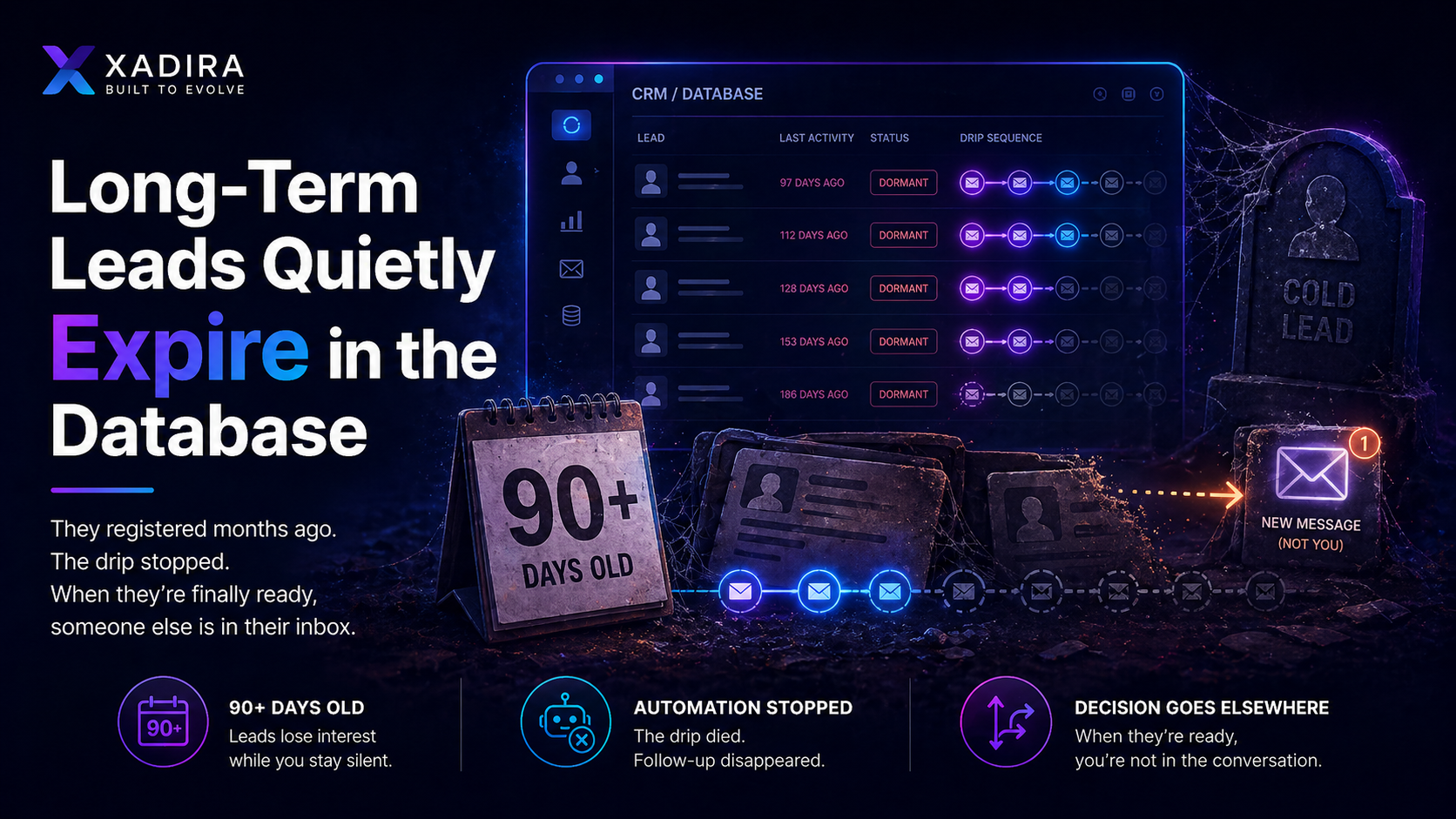
Six months ago, someone registered for your Medicare webinar. They missed it, or they watched and weren't quite ready. They went into your follow-up sequence, received a few emails — and then nothing. Your sequence ran out.
Now it's six months later. They're three months from turning 65. They're ready to make a decision. They sit down and search for a Medicare agent — and they call whoever shows up first.
That person probably isn't you. Not because you didn't do the work. But because you stopped showing up when your sequence ended, and Medicare decisions don't run on a 30-day timeline.
The Real Medicare Decision Timeline
Medicare isn't a purchase someone makes in a day. The decision process for someone turning 65 typically looks like this:
- 12–18 months before 65: They start hearing about Medicare. Maybe from a friend, a mailer. They're not ready — but they're vaguely aware.
- 6–12 months before: They start actually researching. They watch a webinar, read some content, sign up for something. Still not ready to commit.
- 3–6 months before: The timeline is real. They're actively looking for an agent. They remember who they've heard from and who they trust.
- The enrollment window: They make a decision. Whoever is top of mind — and has earned some trust — gets the call.
Most follow-up sequences are built for the last 30 days of this timeline. The agents winning the most clients are the ones who stayed present for the entire 12 to 18 months leading up to it.
The goal of long-term nurture isn't to close the lead today. It's to be the obvious choice when they're finally ready — because you never stopped showing up.
What Happens When Your Drip Stops
Silence reads as disinterest
Prospects don't know your sequence ended. From their perspective, you just stopped caring. An agent who went quiet for four months feels less trustworthy than one who checked in occasionally — with a reminder about enrollment windows, a Medicare cost update, a simple touchpoint that kept the relationship warm.
Other agents fill the gap
You are not the only agent marketing to this person. While your sequence sat silent, other agents' mailers kept arriving, other agents' content kept showing up. Consistency is a competitive advantage — and you gave it up the moment your drip ended.
The lead forgets the relationship existed
By the time a prospect who registered six months ago is ready to buy, they may have genuinely forgotten they attended your webinar. The trust you built is largely gone. You're starting over from scratch with someone who was already warm.
The Math on What's Being Left Behind
Say you've run webinars for a year and you have 400 contacts who registered, didn't immediately convert, and are sitting in your database. Your drip ended at 60 days for all of them.
If 5% of those leads are in an active decision window right now — comparing agents, ready to commit — that's 20 people. If your average Medicare Advantage client generates $500 to $800 in first-year commission, that's $10,000 to $16,000 sitting dormant in your database, waiting for someone to show up.
That number compounds every quarter. And it comes entirely from leads you already paid to generate.
Why "I'll Reach Out When They're Ready" Doesn't Work
You don't know when they're ready
Without a system tracking engagement, you have no signal. You don't know that a prospect opened your last four emails, visited your website twice, and searched for Medicare enrollment dates this week. You'd only know if they reached out — and most people don't initiate contact; they respond to it.
Scale makes it impossible
If you have 400 long-term leads, personally managing timing for each one isn't realistic. The manual workload would consume more hours than the commissions are worth. This is a system problem, not a willpower problem.
You'd have to guess — and you'd often guess wrong
You reach out in January. They're not ready until April. Automated long-term nurture doesn't require perfect timing — it ensures you're present throughout, so when April comes, you're already in their inbox.
What Good Long-Term Nurture Actually Looks Like
The goal isn't volume — it's consistent presence over time. A good long-term nurture track for Medicare leads does a few specific things:
Maintains presence without being aggressive
Checking in every few weeks with something genuinely useful is the right cadence. Medicare cost updates, enrollment window reminders, coverage comparison tips — content that makes them feel informed rather than sold to. You want to be their trusted resource, not a pest.
Reactivates when they show engagement
If a prospect who's been dormant for four months suddenly opens three messages in a row, that's a signal worth acting on. A good nurture system detects that shift and responds with more direct outreach — "Just checking in, are you getting closer to your Medicare decision?"
Never terminates arbitrarily
The biggest flaw in most drip sequences is a hard end date. Long-term Medicare nurture should persist until the prospect converts, opts out, or becomes unreachable. There's no logical reason to stop showing up for someone who hasn't said no.
Standard Drip vs. Long-Term Nurture
Standard drip
- Ends after 30–60 days
- No re-engagement on activity
- No presence during decision window
- Lead forgets you exist
- Other agents win the commission
Long-term nurture
- Runs until opt-out or conversion
- Detects and acts on activity spikes
- Present throughout the full timeline
- You're top of mind at decision time
- You get the call when they're ready
How Xadira Handles the Long Game
Xadira's long-term nurture track is built specifically for this problem. Leads that attend a webinar and don't convert — or miss and go quiet — don't fall off a cliff. They enter a persistent sequence that keeps your name and value in front of them over months, not days.
When a long-term lead shows a spike in engagement, Xadira detects that shift and adjusts outreach automatically. No manual monitoring required. The database you've built through webinars keeps working for you long after the campaign that generated it is over.
Frequently Asked Questions
How often should I reach out to long-term leads?
Every 2 to 3 weeks is a reasonable cadence — frequent enough to stay relevant, not so frequent that you feel like spam. Touchpoints around AEP (Oct–Dec) and around their 65th birthday should be more frequent since those are genuine urgency windows.
Should long-term leads get different content than recent leads?
Yes. Recent leads need education and trust-building. Long-term leads have been through that phase — they need relevance and re-activation. Content that references where they are in their Medicare timeline performs better than general education for this group.
Is it worth nurturing someone who registered over a year ago?
In most cases, yes — especially for Medicare agents. If someone registered a year ago and hasn't converted, they may still be in a pre-decision phase, or approaching a qualifying life event. The cost of maintaining a nurture sequence is minimal compared to the commission on a single conversion.
How do I know which long-term leads are starting to warm up?
Without a tracking system, you don't — and that's the fundamental problem with manual nurture. Xadira monitors engagement signals across channels and surfaces leads showing increasing activity, so you can act on intent when it appears rather than guessing.
Your Database Has More Value Than You Think
Xadira's long-term nurture keeps every lead warm — automatically — so you're the first call when they're ready to make a Medicare decision.
See How Xadira Works