Most agents think their leads said "no." They didn't. Real "no's" are rare. What actually happens is far more boring and far more expensive: the lead gets distracted, the lead forgets, the lead means to come back and never does, the lead waits for a sign that the agent still cares — and the sign never comes.
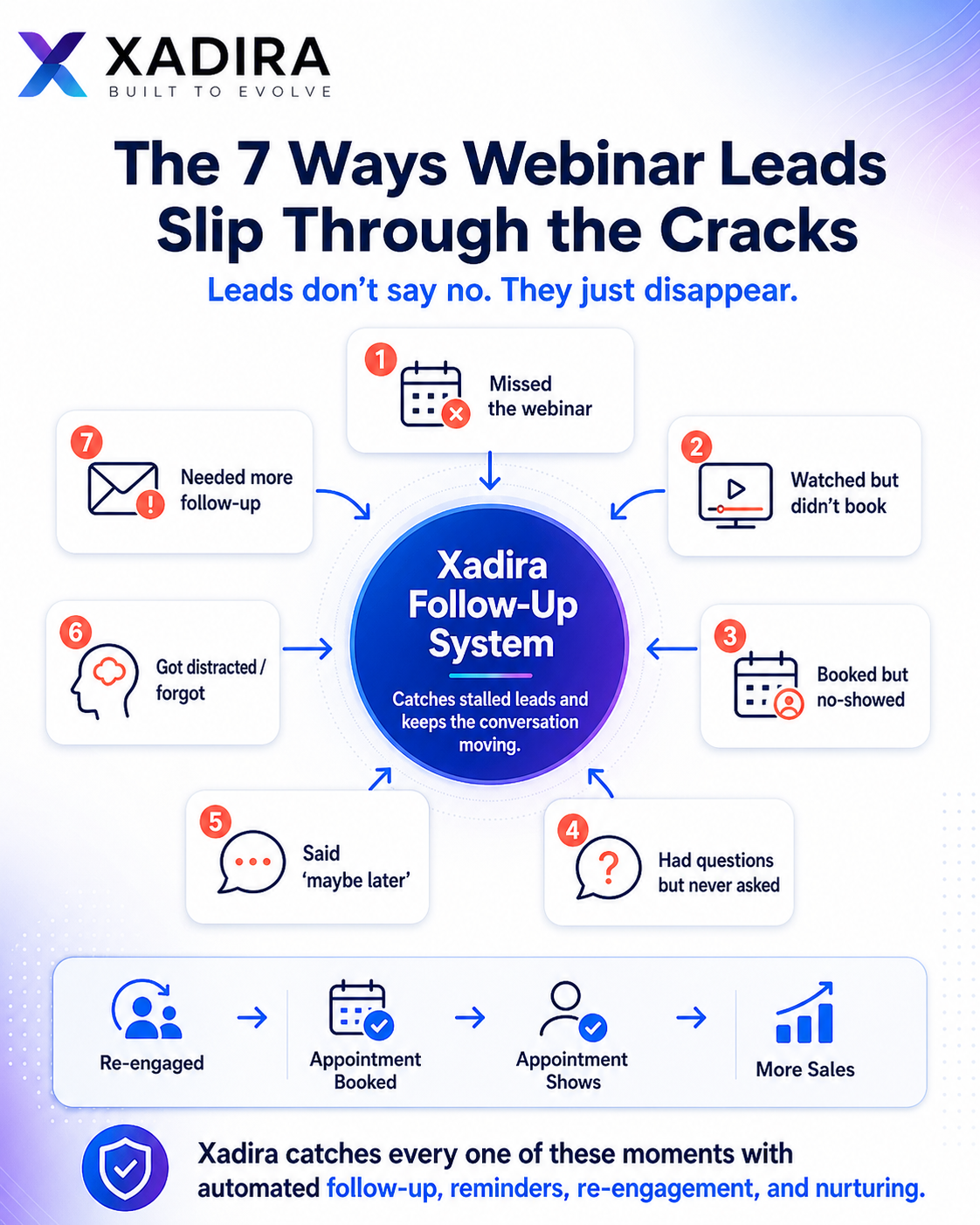
Every webinar funnel loses leads at seven specific moments. Each one looks like a "they weren't interested" loss on the surface. None of them actually are. They're system failures dressed up as customer behavior.
This is a walk through all seven, in the order they tend to occur, with what's actually happening in each case and what a follow-up system needs to do to stop the bleed.
1. They Missed the Webinar
This is where the funnel starts losing money. A registrant signs up enthusiastically — fills out the form, blocks the time on their calendar, fully intending to show up. Then life happens. A grandkid calls. They lose track of time. The link is buried in their inbox. They miss it entirely.
Most agents send a single "sorry you missed it, here's the replay" email and move on. That email gets opened maybe 25% of the time. The rest of those leads — people who were interested enough to register in the first place — quietly disappear.
What's actually happening
The lead is not less interested than the people who showed up. They had the same intent at registration. They just weren't able to be present in the moment. Their interest hasn't changed; their availability did.
What needs to happen
Missed registrants should get an immediate replay link, then a multi-touch sequence over the next week or two specifically designed for absentees: text reminders to watch the replay, a short summary of what they missed, a direct link to book if they're ready, and a re-invite to the next live session if they prefer to attend live. A single email is leaving 75% of these leads on the table.
2. They Watched But Didn't Book
This is your hottest segment, and it's where the most preventable losses happen. They sat through the entire presentation. They heard every value point. They have all the information they need. And then they close the browser and don't book.
Why? Almost never because they decided no. Usually because the moment passed. They wanted to think about it. They wanted to talk to a spouse. They needed to check a calendar. By the time any of that resolved, the urgency was gone and so was the booking link.
What's actually happening
This is a high-intent lead in a low-friction-required moment. They're not skeptical — they're hesitant. They want a small nudge in the right direction, not a hard sell.
What needs to happen
A targeted sequence specifically for attendees who didn't book. The messaging should acknowledge they watched, address the most common reasons people don't book immediately (need to talk to a spouse, want to compare plans, weren't sure about timing), and offer a no-pressure path to schedule. This is not the same sequence as someone who never showed up — and treating it like it is, is the single biggest leak in most agent funnels.
Attendees who don't book are not low-intent leads. They are high-intent leads in a low-friction moment that just passed. Your follow-up needs to recreate that moment.
3. They Booked But No-Showed
They went a step further — registered, attended, and booked an appointment. And then didn't show up to the call. For agents, this is the most frustrating loss because it feels personal. It isn't.
No-shows happen because the booking was a moment of momentum and the appointment is two days later. By the time the appointment rolls around, the prospect has cooled off, gotten busy, forgotten, second-guessed, or just not seen the reminder. The booking was real. The follow-through requires a system.
What's actually happening
The gap between booking and the appointment is where intent decays. Without active reminders and a path to easily reschedule, no-shows become abandonment.
What needs to happen
Pre-appointment confirmations across multiple channels — email and text — at the right intervals. A reminder 24 hours out, another 1 hour out, both with one-click rescheduling. And critically, a no-show recovery sequence that triggers automatically the moment someone misses: a short, non-judgmental message acknowledging life happens and offering to rebook. Most no-shows will rebook if asked promptly. Most agents never ask.
4. They Had Questions But Never Asked
Some of your most qualified prospects sit through the entire webinar with a specific question that's blocking their decision. They didn't ask in the Q&A because they didn't want to type it in front of strangers. They didn't email afterward because they don't want to be a bother. They just left.
That unanswered question is often a single piece of information away from being a closed deal. But because it never surfaced, the lead drifts into "they probably weren't ready" and disappears.
What's actually happening
This prospect is not undecided about Medicare. They are stuck on a specific concern — a coverage detail, a cost question, an eligibility question, a timing question. They want clarity, not pressure.
What needs to happen
Post-webinar follow-up should explicitly invite questions in low-friction ways: a reply-to-this-email prompt, a text-back option, a quick-question booking type that's shorter than a full consultation. The goal is to lower the cost of asking. Once the question gets surfaced, the conversion is usually fast.
5. They Said "Maybe Later"
"This is helpful, but I'm not ready yet" is one of the most common responses to a Medicare webinar — and one of the most poorly handled. Most agents take "not ready" at face value and move the lead into a generic newsletter or stop following up entirely. Both are mistakes.
"Maybe later" almost always means a specific later. It means "I want to wait until I'm closer to my enrollment window." It means "I want to wait until my current coverage ends." It means "I want to wait until I've talked to my spouse who's traveling." It rarely means "never."
What's actually happening
The lead has expressed interest and committed to a future timeline. They've given you permission to follow up — they just need you to actually do it on their schedule, not yours.
What needs to happen
A "maybe later" lead needs a long-term nurture track that stays present through their decision timeline — relevant content, occasional check-ins, and a clear path to book the moment they're ready. The leads who say "maybe later" and then disappear didn't change their minds. They were just no longer being shown up for.
6. They Got Distracted or Forgot
This is the silent majority of lost leads. They were genuinely interested at the moment of registration. They opened the first email. They half-watched the webinar. They thought about booking. And then the world moved on — work deadline, family event, busy week — and the entire interaction faded from memory.
By the time they think about Medicare again, you're not in the picture. Someone else is.
What's actually happening
This isn't a problem of interest. It's a problem of memory. Your follow-up needs to outlast their distraction.
What needs to happen
Persistent, friendly re-engagement that doesn't assume the lead is done. Activity-triggered re-engagement is even better: when a previously dormant lead suddenly opens an email or clicks a link, that's the moment to escalate to direct outreach. The signal is the prospect quietly raising their hand again. The system needs to see it and respond.
7. They Just Needed More Follow-Up
This is the catch-all and the largest category. The lead didn't say no, didn't actively disengage, and didn't have a specific blocker. They simply needed more time, more touches, more reminders before they were going to commit. And because most agents tap out after two or three follow-ups, the lead converted somewhere else — usually with the agent who simply kept showing up.
The data on this is consistent across industries: most conversions happen between the fifth and twelfth touchpoint. Most outreach stops between the second and third. The math is brutal.
What's actually happening
Decisions take longer than agents want them to. Especially Medicare decisions, which involve money, family input, and a sense of permanence. The prospect isn't being difficult — they're being thoughtful. Your follow-up needs to match that timeline.
What needs to happen
A follow-up system that doesn't quit after a fixed number of touches. The right cadence varies by lead behavior — but the principle is constant: stay relevant, stay present, and stop showing up only when the lead opts out, converts, or genuinely becomes unreachable.
The Cost of Each Crack
What most agents do
- One "sorry you missed it" email to absentees
- Generic drip for everyone post-webinar
- Single appointment reminder, no recovery
- No mechanism to surface unanswered questions
- "Maybe later" leads moved to newsletter
- Drip ends after 30–60 days
- 2–3 total touchpoints
What a real system does
- Multi-touch absentee sequence with replay + reschedule
- Distinct sequences for attendees vs. no-shows vs. bookers
- Multi-channel reminders + no-show recovery automation
- Low-friction question prompts in every follow-up
- "Maybe later" leads enter long-term nurture track
- Persistent presence until opt-out or conversion
- 9–15+ touchpoints, intelligently spaced
How Xadira Catches Every One of These Moments
Xadira is built specifically for this problem. Every one of the seven cracks above is mapped to a distinct workflow inside the platform — different sequences, different cadences, different messaging — running automatically based on what each lead actually does (or doesn't do).
Missed the webinar? Triggers the absentee track. Watched but didn't book? Triggers the attendee re-engagement track. Booked but no-showed? Triggers reminders, then a recovery and rebook sequence. Said maybe later? Enters long-term nurture. Went quiet for months? Stays in nurture until activity reappears, then re-escalates.
The point isn't that Xadira sends more emails. The point is that Xadira sends the right message to the right segment at the right time — and never lets a lead silently exit the funnel without making at least one more attempt to bring them back.
Frequently Asked Questions
Doesn't more follow-up annoy people?
Bad follow-up annoys people. Generic, off-target, too-frequent, "just checking in" follow-up annoys people. Relevant, timed, segmented follow-up — content that actually matches where the lead is in their decision — does not. The annoyance comes from messaging that ignores the lead's behavior, not from the volume itself.
How do I know which "crack" a lead fell through?
You can't tell manually at any meaningful scale. The whole point of an automated system is that it tags and segments leads based on their behavior — registered, attended, booked, no-showed, opened, clicked — and routes each one into the appropriate sequence without the agent having to think about it.
Can I just hire a VA to do this manually?
For a small enough volume of leads, yes. For most growing Medicare practices, no — the math stops working pretty fast. A VA can manage 50 leads thoughtfully. They cannot manage 500 across seven different behavioral states with multi-channel touchpoints. This is what automation is for.
Where should I focus first if I can only fix one of these?
"Watched but didn't book" gives you the highest immediate return. These are your warmest leads, they require the least re-engagement effort, and most agents have nothing in place specifically for them. Build a dedicated sequence for this segment first; it pays back the fastest.
Stop Losing Leads You Already Paid to Generate
Xadira closes every one of the seven cracks automatically — so the leads you've already paid for actually convert into clients.
See How Xadira Works